
Snow Day Tomorrow? How to Tell Tonight and Get Ready
Quick answer: You’ll probably have a snow day tomorrow if a Winter Storm Warning, Ice Storm Warning or Blizzard Warning covers your county and the worst snow or ice is forecast between about 2 a.m. and 8 a.m. Check the hourly forecast at weather.gov tonight, run our snow day calculator for a percent chance, and watch your district’s alerts. Most decisions land by around 5 a.m.
The tricky part is that tomorrow’s forecast keeps moving tonight. This page shows you how to read it hour by hour, which signals matter, when to check again, and how to plan for both answers so the morning isn’t a scramble.
Check your snow day chance
An estimate from the NWS forecast, not an official closure. Always confirm with your school or district. How schools decide snow days
The three signals that point to a snow day tomorrow
You don’t need a meteorology degree. Three things answer most of the question.
1. An active NWS alert
Go to weather.gov and enter your ZIP code. If a red or pink alert banner shows a Winter Storm Warning, Blizzard Warning or Ice Storm Warning for the morning, your odds are high. A Winter Weather Advisory means trouble but usually points to a delay rather than a full closure.
2. Snow or ice during bus hours
Buses in many districts start rolling around 6 a.m. If heavy snow or freezing rain is falling between about 4 a.m. and 8 a.m., crews can’t clear roads in time. Snow that ends at 10 p.m. gives plows all night.
3. Your area’s normal winter
Two inches can close every school in Atlanta and not a single one in Minneapolis. Compare tomorrow’s forecast with what your area usually handles. If the storm is big for your town, odds rise.
| Signal tonight | Snow day tomorrow odds |
|---|---|
| No alert, light snow ending before midnight | Low |
| Winter Weather Advisory, 2–4 inches overnight | Medium; delay likely |
| Winter Storm Warning, heaviest snow 3–8 a.m. | High |
| Ice Storm Warning or freezing rain at bus time | High |
| Blizzard Warning or city travel ban | Very high |
| Extreme Cold Warning for the morning | Medium to high, depending on district |
For a single number that combines these signals for your ZIP code, use our snow day calculator.
How to read tonight’s forecast
The forecast on your phone’s weather app is a summary. For a snow day tomorrow, you want the hour-by-hour detail.
- Open weather.gov and search your city or ZIP code.
- Read the alert banner at the top first.
- Scroll to “Detailed Forecast.” Look at “Tonight” and the next day for snow totals and start times.
- Open the “Hourly Weather Forecast” graph. It shows temperature, wind and precipitation chance by the hour. Look at the hours from midnight to 9 a.m.
- Check the temperature line. If it sits right at 32°F during the morning, expect a mix of rain, sleet and freezing rain, which is harder to predict.
- Look for the Area Forecast Discussion link. Local forecasters explain how confident they are, in plain notes written for other forecasters.
Snow totals vs. snowfall rate
A forecast of “4 to 7 inches” sounds the same whether it falls over 6 hours or 24. Rates of an inch an hour or more during the commute are what overwhelm plows. Look for wording like “heavy snow at times” or “snowfall rates of 1 to 2 inches per hour.”
The Winter Storm Severity Index
The NWS also publishes a Winter Storm Severity Index map that rates expected impacts from limited to extreme. If your area shows moderate or higher for the morning, that’s another strong hint.
A night-before timeline
Here’s a simple schedule that keeps you from refreshing every 10 minutes.
| Time | What to do |
|---|---|
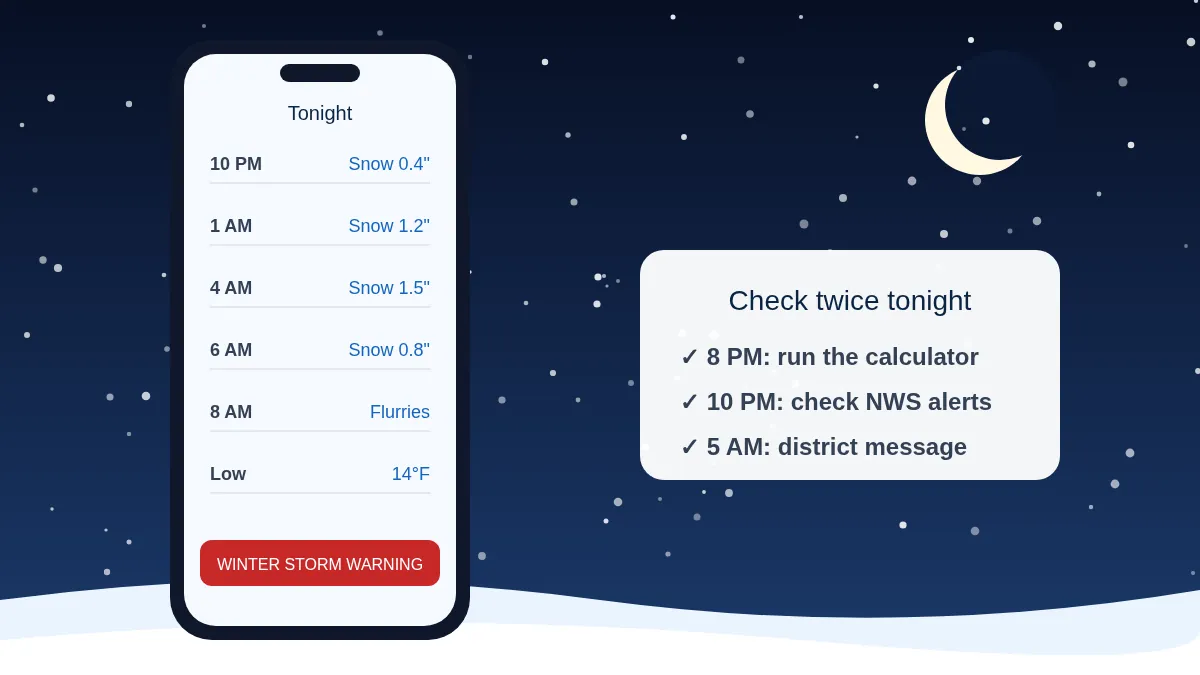
| 6–8 p.m. | Check weather.gov alerts and run the calculator |
| 8–9 p.m. | Look for early announcements; big storms sometimes get called now |
| 10–11 p.m. | Check once more; late forecast updates often arrive in the evening |
| Before bed | Set an early alarm if odds are 50% or higher |
| 5–6 a.m. | Check district texts, email and website for the final word |
New York City Public Schools says it announces as early as possible before 5 a.m. Denver Public Schools aims for a 5 a.m. decision. Most districts follow a similar rhythm. If you’re checking in the morning instead, our snow day today guide is built for that moment.
When a forecast changes overnight
Sometimes you go to bed at 90% and wake up to a normal school day. Here’s why.
- The storm slowed down. Snow that arrives at noon instead of 4 a.m. usually means school opens, possibly with an early dismissal.
- Warm air won. The rain-snow line moved north, and you got slush instead of snow.
- The storm sped up. It ended by 2 a.m., and plows had hours to work.
- The district chose a delay. A two-hour delay lets the sun and plows do their work.
- The district went remote. Some districts, like NYC, hold class online instead of closing.
Districts read the latest forecast at 4 or 5 a.m., not the one you saw at 9 p.m. That’s why a late check matters.
Snow day odds by day of the week
The day matters more than people think.
- Monday: Weekend snow gives crews two days to clear roads. A storm arriving late Sunday night is the one to watch.
- Tuesday to Thursday: Normal odds, based on the forecast.
- Friday: Some superintendents are a little quicker to call it, since there’s a weekend to recover. That’s a tendency, not a rule.
- After a long break: Districts may be cautious if buses and buildings haven’t been checked in days.
Our calculator lets you pick a weekday, so you can check Monday’s odds on a Sunday afternoon.
Get ready tonight either way
The best plan is one that works for both answers.
If a snow day is likely
- Line up childcare or a work-from-home plan now
- Charge laptops and tablets in case your district switches to a remote day
- Find your child’s school login details
- Put boots, gloves and sleds by the door
- Check whether after-school activities, sports or games are also canceled
If school is likely open
- Lay out warm layers: hat, gloves and a waterproof jacket
- Leave extra time; roads and sidewalks may be slick
- Pack a spare pair of socks
- Confirm the bus is running on time
Kids waiting at a bus stop in dangerous cold need the most care. If an Extreme Cold Warning is out, cover exposed skin and keep the wait short.
Snow day superstitions
Every student knows at least one. None of them work, but they’re part of the fun, and kids have passed them down for decades.
- Wear your pajamas inside out (or backwards) to bed
- Put a spoon under your pillow or in the freezer
- Flush ice cubes down the toilet
- Run around the kitchen table a set number of times
- Put a white crayon on the windowsill
Sharing them on a snowy night is a tradition in many homes. Just keep the ice cubes to a few, and check the forecast too.
Watch: winter storm watch vs. warning
This FOX61 explainer covers the difference between a winter storm watch and a warning, which is the first thing to check the night before.
 Winter Storm Watch vs Winter Storm Warning EXPLAINED – FOX 61
FAQs
What time do schools announce a snow day for tomorrow?
For big, certain storms, some districts announce the evening before. Most decide between about 4:30 and 5:30 a.m. after staff check the roads, and alerts go out by about 6 a.m.
Is a Winter Storm Watch enough for a snow day tomorrow?
Usually not on its own. A watch means a storm is possible. The odds climb when it becomes a warning and the timing hits the morning commute.
Why do nearby districts get a snow day when we don’t?
Each district decides for itself, based on its roads, bus routes and spare days. Our guide on how schools decide snow days walks through the full process.
Can it be a snow day tomorrow with no snow?
Yes. Ice from freezing rain or an Extreme Cold Warning at bus time can close schools without any real snowfall.
Conclusion
You can usually tell if there’s a snow day tomorrow before bed. Check for an NWS warning, look at the hourly forecast for 2 a.m. to 8 a.m., compare it with what your area normally handles, and check again around 10 p.m. Then let your district’s 5 a.m. alert make it official.
Plan for both outcomes tonight, and the morning gets easy: either you sleep in, or you’re out the door warm and on time. Want to know whether your school is officially closed? Use our will school be closed tomorrow checklist.