
Snow Day Michigan Guide 2026–27: Forgiven Days, the Law and Your Odds
Quick answer: Michigan law lets each district count the first 6 days (or the same number of hours) lost to conditions like severe storms as instruction, so they don’t have to be made up. If a district needs more, the State Superintendent can approve up to 3 extra days. Anything beyond that has to be made up to reach the state’s 180 days and 1,098 hours. Each district’s superintendent decides when to close.
That’s the short version of how a snow day in Michigan works. Below you’ll find what the law actually says, what happens once the six days run out, why lake-effect snow makes some districts close far more than others, and how to check your district’s odds.
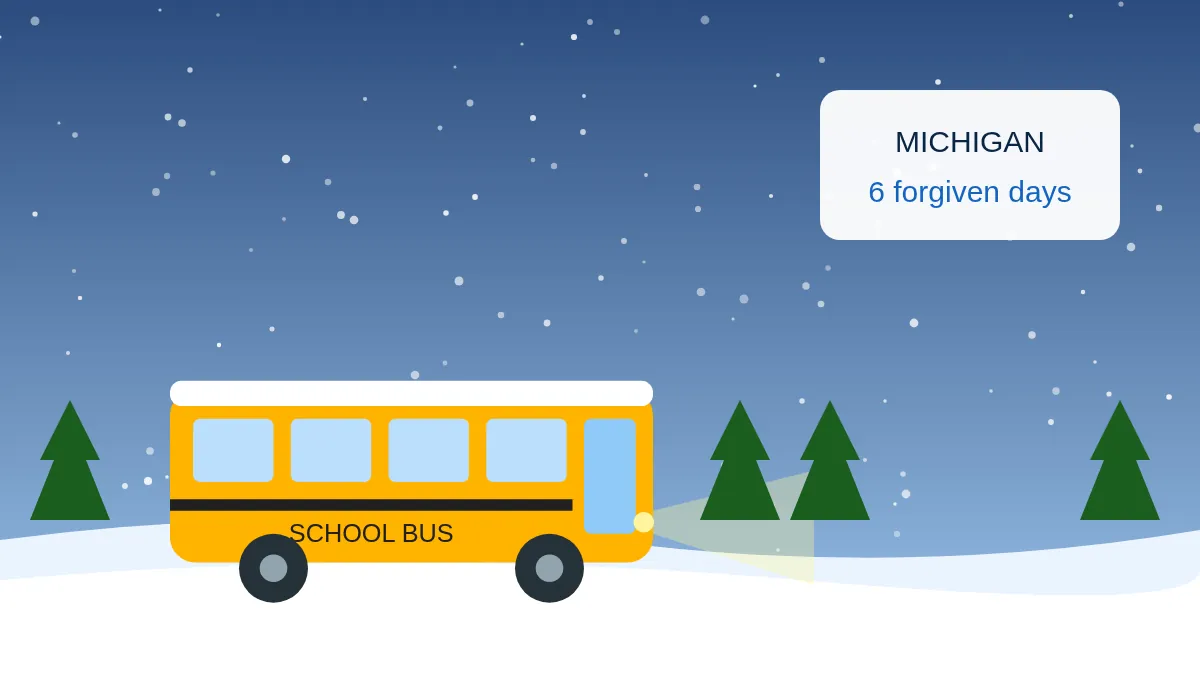
Snow day chance for Detroit, Michigan
An estimate from the NWS forecast, not an official closure. Always confirm with your school or district. How schools decide snow days
Michigan’s snow day law in plain English
The rules sit in Section 101 of the State School Aid Act, MCL 388.1701. Here are the key numbers.
| Rule | What it means |
|---|---|
| 180 days and 1,098 hours | Minimum instruction every district must provide each year |
| First 6 days (or equal hours) forgiven | Lost days from storms, fires, power loss and similar events still count |
| Up to 3 more days with approval | The State Superintendent can approve them for unusual circumstances |
| Beyond that | Days must be made up, or the district risks losing state aid |
The Michigan Department of Education calls the extra three days a “snow-day waiver.” Its guidance also stresses that Michigan is a “local control state,” meaning each district decides when to close. The state only sets how many lost days can be forgiven.
What counts as a forgiven day?
The law doesn’t say “snow day.” It says days when instruction isn’t provided “because of conditions not within the control of school authorities.” The examples it gives include:
- Severe storms
- Fires
- Epidemics
- Power outages
- Water or sewer failure
- Health conditions defined by city, county or state health authorities
So an ice storm, a blizzard, a cold day or a broken water main can all use up one of the six. That’s worth knowing in February: a district that lost a day to a power outage in the fall has fewer left for snow.
A two-hour delay is different. Students still get some instruction that day, so it isn’t a full lost day. Since the law also counts hours, ask your district how it tracks delay time.
What happens after six snow days?
Once the six forgiven days are gone, districts have a few choices.
- Ask for the waiver. The district applies to the State Superintendent for up to 3 more forgiven days. Approval isn’t automatic.
- Add make-up days. These often go at the end of the year, or replace planned days off like a professional development day.
- Add time to the school day. Some districts make up lost hours a few minutes at a time.
In past heavy winters, families have seen a mix of all three. Each district announces its own plan, so check your district’s calendar after a run of closures.
Can Michigan schools use virtual days instead?
Some Michigan districts hold online or “e-learning” days during storms instead of closing. How those days count depends on state rules and each district’s approved plan. We couldn’t confirm a single statewide rule for 2026–27, so ask your district directly.
The 2025–26 exceptions
The current law also contains one-time extras for the 2025–26 school year only.
- Districts in 42 northern Lower Peninsula and Upper Peninsula counties, such as Grand Traverse, Marquette and Houghton, could count up to 4 extra days if they couldn’t hold class on March 12, 13, 16 or 17.
- Districts in counties named in Executive Orders 2026-7 or 2026-9 could count up to 5 extra days.
- Districts in counties named in Executive Order 2026-11 could count up to 4 extra days.
These don’t carry over. For the 2026–27 winter, the standard 6 days plus the possible 3-day waiver apply unless lawmakers change the rules again.
Who decides a snow day in Michigan?
Your district superintendent. On a stormy morning, the process often looks like this:
- Transportation staff drive bus routes in the early hours, often around 4 a.m.
- The superintendent checks the National Weather Service forecast and alerts.
- Nearby superintendents talk by phone or text, since many students live near district lines.
- The call goes out by text, email, phone, website and local TV, usually before buses leave.
Because superintendents compare notes, a whole county often closes together. Our page on how schools decide snow days goes deeper into the decision.
Why some Michigan districts close more often
Lake-effect snow
Cold air crossing Lake Michigan and Lake Superior picks up moisture and drops it as heavy, narrow bands of snow. West Michigan and the Upper Peninsula get hit hardest. A band can bury one town while the next stays nearly dry.
Rural roads and long bus routes
Rural districts in places like the Thumb or northern Michigan run buses over long distances on county roads that get plowed after main highways. A dirt road with drifting snow can close a district on its own.
Extreme cold
Michigan also closes for cold. When the National Weather Service issues an Extreme Cold Warning for the morning, many districts cancel to keep kids from waiting at bus stops.
| Region | Main snow day trigger |
|---|---|
| Metro Detroit | Ice storms and heavy snow during the commute |
| West Michigan (Grand Rapids, Muskegon) | Lake-effect snow bands |
| Mid-Michigan (Lansing, Flint, Saginaw) | Heavy snow, drifting on rural roads, extreme cold |
| Northern Lower Peninsula | Heavy snow and long rural bus routes |
| Upper Peninsula | Extreme cold, blizzards and very heavy lake-effect snow |
These triggers are general patterns, not official thresholds. Each district sets its own limits.
How to check your Michigan snow day odds
- Run our snow day calculator with your ZIP code. Set “snow days already used” so the tool knows how many forgiven days your district may have left.
- Check weather.gov for alerts from your local NWS office.
- Watch your district’s alerts and local TV closing lists by 5–6 a.m.
If the forecast is close, see our tips on reading tonight’s forecast in snow day tomorrow.
Watch: how Michigan districts manage snow days
This Local 4 (WDIV) report covers how Michigan school districts handle snow days and what happens as the forgiven days get used up.
 Michigan school districts managing snow days – Click On Detroit | Local 4 | WDIV
FAQs
How many snow days are allowed in Michigan?
Six forgiven days (or the same hours) a year under MCL 388.1701, plus up to three more if the State Superintendent approves a waiver.
Do Michigan students have to make up snow days?
Only after the forgiven days run out. Beyond 6 days, plus any approved waiver days, districts must add time to meet 180 days and 1,098 hours.
Does a cold day count as a snow day in Michigan?
Yes. Any closure caused by conditions outside the district’s control, including dangerous cold, uses one of the forgiven days.
Who decides if there’s a snow day in Michigan?
The local superintendent. The state sets the forgiven-day limit, but it doesn’t decide closures.
Conclusion
A snow day in Michigan comes down to two things: your superintendent’s call on the morning, and a state law that forgives 6 lost days, with up to 3 more by waiver. After that, days get made up.
So keep an eye on how many your district has used, especially after a stormy January. Then check your odds the night before, and watch for the 5 a.m. alert.