
Snow Day for Schools: How Districts Really Decide to Close
Quick answer: In most US districts, the superintendent decides whether to call a snow day for schools. The call usually comes between about 4:30 and 5:30 a.m., after transportation staff drive bus routes, the team reads the National Weather Service forecast, and nearby superintendents compare notes. Safety on roads and at bus stops comes first, then building conditions, staffing and how many days the district can afford to lose.
It looks like a simple yes or no from the outside. On the inside, it’s a short, stressful morning with incomplete information. Here’s how the process actually works, what weighs most, and why your district sometimes makes a call that seems wrong.
Check your snow day chance
An estimate from the NWS forecast, not an official closure. Always confirm with your school or district. How schools decide snow days
Who decides?
In nearly every US district, the superintendent makes the final call. School boards set the policy, but they don’t vote at 5 a.m.
The superintendent rarely decides alone. Denver Public Schools, for example, says the superintendent decides based on information from the district’s transportation team, local transportation agencies and the weather bureau. In big cities, the mayor can be involved too. In New York City, the mayor and schools chancellor announced the February 23, 2026 closure together.
States usually stay out of the daily decision. Michigan’s Department of Education calls Michigan a “local control state” where superintendents decide closures, sometimes daily in winter.
The early-morning timeline
Every district has its own rhythm, but most snowy mornings follow a pattern like this.
| Time | What happens |
|---|---|
| Day before | Leaders watch forecasts and NWS briefings; they may warn families |
| Evening | Early call if a major storm or travel ban is certain |
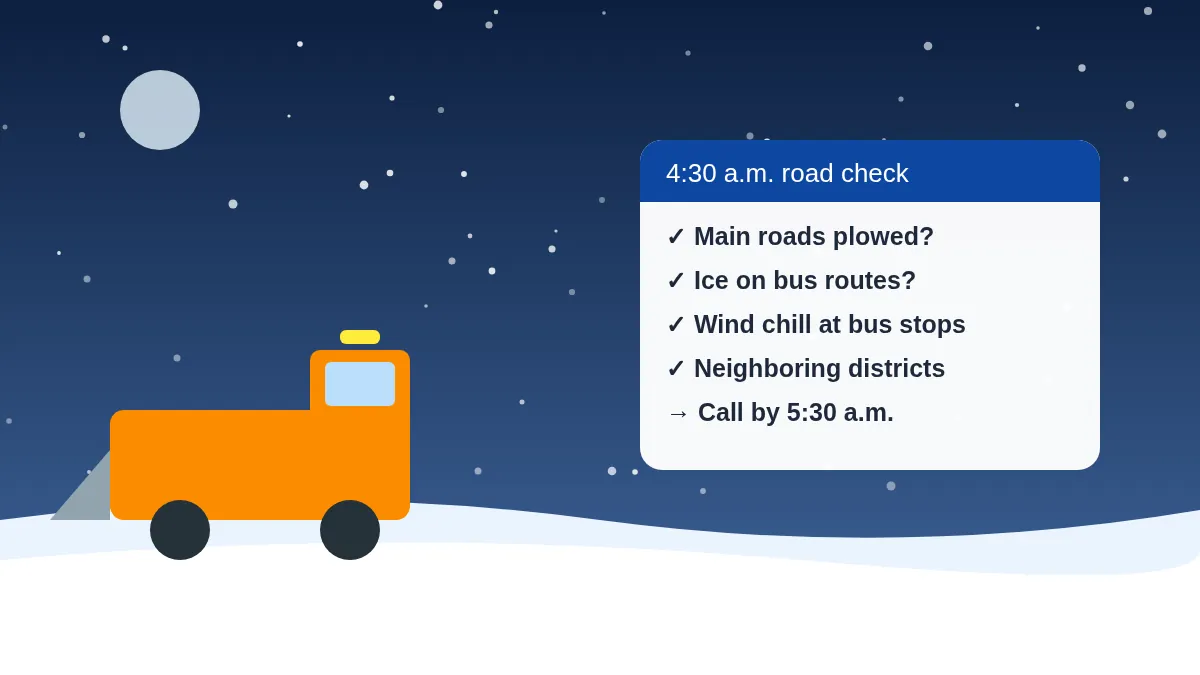
| 3:30–4:30 a.m. | Transportation staff drive bus routes and check side roads |
| 4:00–5:00 a.m. | Superintendent reviews road reports, forecast and radar |
| 4:30–5:15 a.m. | Calls with nearby superintendents, city road crews and bus companies |
| By about 5:00–5:30 a.m. | Decision made |
| 5:00–6:30 a.m. | Alerts sent by text, call, email, website, social media and TV |
Denver Public Schools says its goal is a 5 a.m. decision. New York City Public Schools announces as early as possible before 5 a.m. Both targets exist for the same reason: buses and staff start moving soon after.
What districts weigh
A snow day for schools comes down to safety first, then logistics. These are the main factors.
Roads and bus routes
Can a 40-foot bus stop safely on every street on its route, including hills and back roads? Main roads may be clear while side streets are still sheet ice. That’s why staff drive the actual routes, not just the highway.
Bus stops and walkers
Students waiting at stops or walking to school face the cold and slippery sidewalks directly. An Extreme Cold Warning from the National Weather Service can close schools even without snow.
Timing of the storm
Snow ending at midnight gives plows time. Snow peaking at 6 a.m. doesn’t. A storm forecast to start mid-morning may lead to a normal start with an early dismissal instead.
Forecast confidence
A forecaster’s “4 to 8 inches” is a range, not a promise. Superintendents often call local NWS offices or private forecasters to ask how sure they are. Many NWS offices hold briefings for school and emergency officials before big storms.
Buildings and staff
- Are parking lots and sidewalks plowed?
- Is there power and heat in every building?
- Can teachers, bus drivers and cafeteria staff get there?
- Are there enough bus drivers to cover routes?
Days left on the calendar
States set minimum days or hours. If a district has used its spare days, the superintendent may lean toward a delay instead of a closure.
What neighbors are doing
Families often live in one district and work in another. Superintendents talk to each other so a whole region can move together.
| Factor | Why it matters | Who checks it |
|---|---|---|
| Road and route conditions | Bus safety | Transportation staff |
| Forecast and timing | When roads will be worst | Superintendent, NWS, forecasters |
| Cold and wind chill | Bus stop safety | NWS alerts |
| Building power and heat | Can students be inside safely | Facilities staff |
| Staffing | Can buses and classes run | HR and transportation |
| Calendar days left | Make-up days | Superintendent and board |
Why nearby districts make different calls
You’ve probably seen it: the district next door calls a snow day for schools while yours stays open. Common reasons:
- Different roads. A rural district with hills and long bus routes faces more risk than a compact city district.
- Different plow schedules. City and county crews clear different roads first.
- Different start times. A district starting at 9 a.m. has more time than one starting at 7:30 a.m.
- Different calendars. One district may have spare days; the other may not.
- Remote options. Some districts can switch to a remote day; others can’t.
- Local storm totals. Lake-effect bands or elevation can drop very different amounts a few miles apart.
Snow day, delay, early release or remote day
A full snow day for schools isn’t the only option. Districts pick from these tools.
| Option | Best for | Example |
|---|---|---|
| Full closure | Heavy snow or ice at bus time, or dangerous cold | DPS closed all schools on May 6, 2026 |
| Delayed start | Snow ending early, roads improving | DPS buses pick up two hours later on weather delay days |
| Early dismissal | Storm arriving during the school day | Afternoon buses run early |
| Remote learning | Districts with remote plans and devices at home | NYC’s default when buildings close |
Remote learning is the biggest change since 2020. Some districts use it to protect the calendar. Others, like Denver Public Schools, have said remote learning isn’t fair when students no longer have school computers at home, so they use real snow days.
The rules on lost days
Each state sets how many instructional days or hours schools must provide, and whether lost days get forgiven.
- Michigan: Districts must provide 180 days and 1,098 hours. The first 6 days lost to things like severe storms are forgiven, and the State Superintendent can approve up to 3 more. See our Michigan snow day guide.
- New York: The state requires 180 days of instruction. NYC received a state waiver for its February 23, 2026 snow day.
Rules vary a lot by state, so check with your state education department for the details.
How families are told
Once a snow day for schools is called, districts use every channel at once:
- Automated texts, calls and emails
- A banner on the district website
- District Facebook and X accounts
- Local TV and radio closing lists
- Phone hotlines in some districts, such as Denver’s 720-423-3200 closure line
Keep your contact details current with your school, or you may be the last to hear. For tips on finding the call fast, use our will school be closed tomorrow checklist.
The hard trade-offs
Superintendents often say the snow day call is a decision where someone will be unhappy either way.
- Close too fast, and working parents scramble for childcare, students miss meals, and the district may add a make-up day.
- Stay open too long, and buses slide, kids wait in dangerous cold, and staff drive unsafe roads.
Schools also provide meals, health care and support services, which is why districts such as Denver Public Schools say they try to stay open when possible. That tension explains most “why did they do that?” moments.
Watch: how one superintendent makes the call
This WTRF report follows how the Ohio County, West Virginia superintendent decides between a snow day and remote learning.
 How does the Ohio County superintendent decide snow days over remote learning? – WTRF
FAQs
Who decides if there’s a snow day for schools?
The district superintendent, usually after input from transportation staff, road crews, forecasters and nearby districts.
What time do superintendents decide snow days?
Most aim to decide by about 5 to 5:30 a.m. so families can be alerted before buses leave. Big storms are sometimes called the evening before.
How cold does it have to be for a snow day?
There is no national number. Each district sets its own limits, often tied to wind chill at bus-stop time and NWS cold alerts. Northern districts usually tolerate much colder mornings.
Why don’t schools just go remote every time?
Not every family has a device or reliable internet, and some districts feel remote days don’t teach much. Others go remote to protect the calendar.
Conclusion
A snow day for schools isn’t a guess. It’s a pre-dawn routine: drive the routes, read the forecast, check buildings and staff, talk to neighbors, and decide by about 5 a.m. Safety on roads and at bus stops leads, and the calendar and family needs shape the rest.
Knowing that process helps you predict the call yourself. Try our snow day calculator the night before, and you’ll often know the answer before the superintendent makes it.